“Monday 5 Things” ….. Over-Edited …..
26.10.19 by D. Paul Graham
Because Mondays are easier when you realize that life doesn't need another filter, another adjustment, or someone moving the saturation slider to eleven.
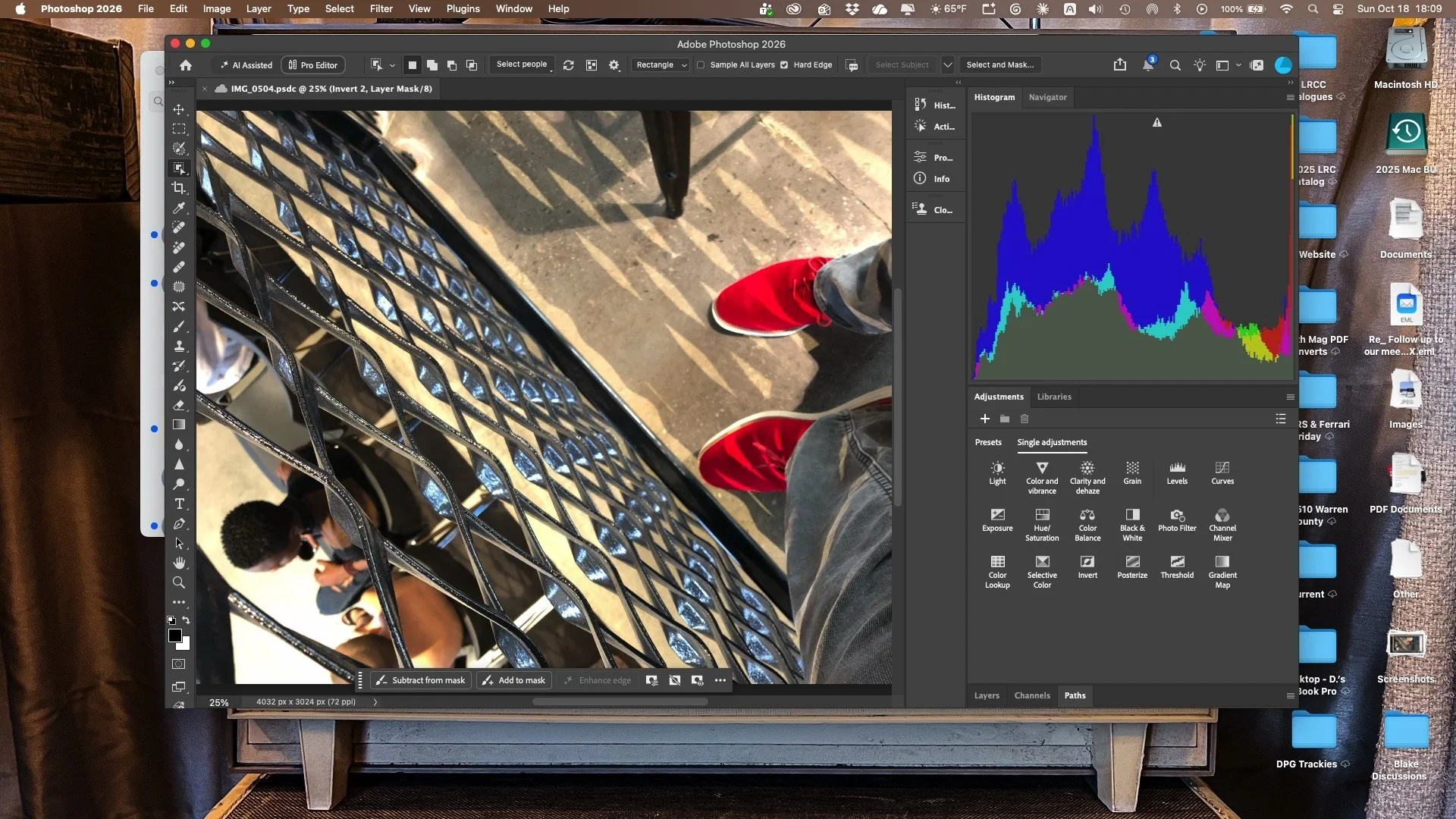
“Processing is a Process” The art of editing is knowing what to leave alone. Photo by D. Paul Graham, Keho Iron Works, Savannah GA circa 2018
I have a pet peeve. Actually, I have several, but this one involves over-edited photographs. You’ve seen them. Skies so dramatic they suggest the Second Coming is scheduled for 4:15 this afternoon. Landscapes with colors that nature never authorized. Portraits where skin has been smoothed to the consistency of Tupperware, eyes glow like radioactive marbles, and teeth so white they could guide F-35’s onto the flight deck of the USS Gerald R. Ford.
Somewhere between the camera and the computer, reality was apparently deemed insufficient. It happens when the pursuit of perfection becomes the enemy of authenticity. Now, before anyone accuses me of photographic hypocrisy, I should point out that editing is hardly a modern invention.
Consider Ansel Adams. Arguably one of world’s greatest photographers, who was a master of darkroom manipulation. His famous photographs weren't simply captured. They were interpreted. Through extraordinary control of exposure, dodging, burning, and contrast, he transformed negatives into prints that conveyed not merely what he saw, but what he felt.
Adams edited with intention, not excess. Every darkroom tool he used served the image. He understood a principle that extends well beyond photography. Editing is an exercise in judgment. The art lies not simply in knowing what can be changed, but in recognizing what should be left alone.
All of which got me thinking. Photography isn't the only thing we've taken to over-editing. Somewhere along the way, we've developed an almost compulsive need to enhance, polish, curate, optimize, and otherwise improve things that might have been perfectly wonderful before we started meddling. We've become a society of people adjusting the saturation slider of life itself.
This morning’s M5T reveals five things we might consider leaving a little closer to their original exposure.
1. THE OVER-EDITED LIFE. When your personal highlight reel needs its own public relations department. We've become remarkably talented at presenting lives that bear only a passing resemblance to the ones we're really living.
Social media is filled with immaculate kitchens, spectacular vacations, blissful marriages, and children who apparently arrived from the factory fully assembled, well-mannered, and incapable of spilling grape juice.
Every sunrise is inspirational. Every vacation is transformative. Every meal is worthy of a Michelin inspector. Meanwhile, just outside the carefully cropped social media post, reality is sitting in a stained bathrobe, drinking reheated coffee, the kids are planning a coup, and the parents are seriously considering an unconditional surrender.
The trouble begins when we compare our behind-the-scenes reality with someone else's professionally produced highlight reel. We start believing everyone else has discovered some secret formula for happiness, when they've simply discovered better lighting and the delete button.
There's nothing wrong with sharing our best moments. But life isn't supposed to be an uninterrupted sequence of best moments. The ordinary, occasionally chaotic intervals are where most of the best stories begin.
A life worth living should be considerably more valuable than a life worth posting. If your entire existence looks like a luxury lifestyle advertisement, I begin to wonder if you’ve mastered the art of editing instead of the more difficult art of living.
2. THE OVER-PROCESSED CONVERSATION. When saying what you mean requires legal counsel. There was a time when people could exchange opinions without conducting a preliminary risk assessment. Today, conversations have become exercises in verbal gymnastics, where the objective is to say something meaningful without risking the inconvenience of actually meaning it. We qualify our observations, soften our disagreements, and wrap perfectly ordinary thoughts in so much diplomatic packaging that the original message becomes impossible to locate.
Even a simple question like "Where should we have dinner?" can trigger an international summit involving dietary restrictions, online ratings, parking considerations, and whether anyone is emotionally prepared to eat Italian again. We've confused being thoughtful with being endlessly cautious and being agreeable with being authentic.
Of course, words matter. Kindness matters. Unfortunately, knowing when to keep your mouth shut has become an underappreciated, underutilized social skill. Particularly at family gatherings, HOA meetings, , and comments on Facebook, where silence is frequently the only evidence of intelligent life.
There's wisdom in speaking plainly, listening generously, and allowing a conversation to be something other than a contest for the most carefully constructed response. Honesty without kindness is cruelty. Kindness without honesty is often just expensive window-dressing. It seems that we’ve lost the understanding that "I disagree" can be a complete sentence that doesn't require a dissertation, a support group, a UN resolution, or an apology tour.
3. THE OVER-ENGINEERED EXPERIENCE. When even relaxation has performance standards. We've reached a peculiar moment in time when apparently nothing can simply be enjoyed. It must be curated, elevated, immersive, or transformative.
Coffee is no longer coffee. It's a single-origin, ethically sourced, hand-poured spiritual awakening with notes of citrus, dark chocolate, and a faint suggestion of unresolved childhood trauma. Dinner has become an immersive culinary journey, usually involving seven courses, fourteen adjectives, and a bill requiring sophisticated financing. Hotels offer wellness experiences designed to help us recover from the stress of paying for them. Vacations require spreadsheets, color-coded itineraries, and the logistical precision of a SpaceX launch.
Imagine explaining to your great-grandfather that your $1,000 wristwatch has diagnosed a poor night’s sleep, even though you were unconscious for eight hours. He'd probably suggest getting rid of the watch and remind you that sleep used to be something we did rather than something we graded.
I genuinely appreciate excellence. A wonderful meal, a beautifully designed hotel, or a well-executed event can be memorable. But excellence shouldn’t require an accompanying theatrical production. Sometimes all the elaborate enhancements distract us from the simple pleasure that brought us there in the first place. We’ve become so preoccupied with making an experience extraordinary that we forget to experience it. The quality of a moment shouldn’t measured by how elaborately it's arranged, but by how completely we're present for it.
Some of life's finest memories involve a folding chair, good company, and a cold beverage. Combined with a backyard cheeseburger that doesn't require a biography of the cow, or a pizza that doesn’t require a tasting narrative and tearful account of the emotional journeys of the pepperoni, mushrooms, and cheese.
4. THE OVER-ANALYZED DECISION. When spreadsheets, algorithms, and artificial intelligence become substitutes for actual intelligence. Having spent much of my professional life in finance, I have great respect for thoughtful analysis. Numbers illuminate problems, expose risks, and occasionally reveal that someone's brilliant idea should remain just that. An idea. Preferably one that never encounters actual capital.
I've also watched analysis become a competitive endurance sport. We produce forecasts, sensitivity studies, and alternative scenarios, followed by elaborate presentations explaining why we need more of all three. Eventually, the original decision has retired to Florida, taken up pickleball, and forgets that the turn-signal has been on for 5 miles.
Enter artificial intelligence, a remarkable technology capable of analyzing mountains of information in seconds, generating sophisticated recommendations, and explaining with breathtaking confidence why we should consider another seventeen possibilities. It’s essentially a tool that allows us to overthink at the speed of light.
I use AI enthusiastically, but there's a meaningful difference between artificial intelligence and actual wisdom. One can process a million data points before breakfast. The other knows when to stop analyzing and order the eggs.
Our unlimited access to information has created the illusion that enough research can eliminate uncertainty. We consult another expert, build another model, ask AI for a second opinion, then ask another AI whether the first AI knows what it's talking about. We end up conducting a digital referendum among algorithms that will never have to live with the consequences.
Wisdom isn't knowing everything before making a decision. It's knowing when you know enough, trusting your judgment, and having the courage to own the outcome. Experience and instinct still matter, particularly when the available data offers more possibilities than answers.
The cost of indecision rarely appears as a line item on a financial statement, but that doesn't make it any less expensive. If your spreadsheet has seventeen tabs, AI has recommended six restaurants, and you're still debating dinner, you've probably missed it.
Fortunately, the algorithm can recommend an excellent place for breakfast.
5. THE OVER-EDITED SELF. When personal improvement becomes a full-time renovation project. Perhaps our most ambitious editing project is ourselves. We're constantly encouraged to become better, faster, healthier, happier, more productive, more attractive, and more emotionally intelligent. There are books to read, habits to develop, metrics to monitor, and experts eager to explain why the person we've spent decades becoming is merely an outdated beta version.
I believe in learning, improving, and occasionally admitting that my first opinion wasn't necessarily my finest work. However, self-improvement can become self-rejection when we begin treating every imperfection as a defect requiring immediate correction.
Consider the character of an old automobile. Its patina, worn leather, and occasional mechanical eccentricity tell a story that a flawless restoration can sometimes erase. There is a difference between preserving something valuable and polishing away its identity.
People are much the same. Our quirks, mistakes, scars, and occasionally inappropriate sense of humor are evidence of a life experienced rather than merely observed. The purpose of self-improvement shouldn’t be to become someone else. It's to become more fully and thoughtfully who we already are.
Of course, some rough edges genuinely need attention. There's a meaningful difference between having character and simply being difficult, but perfection is an exhausting ambition, especially when the specifications keep changing.
As a personal favor, if you've achieved nirvana and become the perfect version of yourself, please resist announcing it all over social media. The rest of us are still wandering into rooms without remembering why, searching for reading glasses perched on our heads, trying to remember our passwords, and questioning whether caffeine is the last true vestige of civilization.
Here’s to a week of recognizing that sometimes the most sophisticated thing we can do is resist the temptation to make one more adjustment.
© 2026 D. Paul Graham / imageGRAHAM, llc, All Rights Reserved
Paul continues to embrace life's imperfections, while reserving the right to Photoshop out the occasional idiot.
Subscribe to “Monday 5 Things” by clicking here: www.Monday5Things.com
Do you know someone who could use a better Monday? Send this their way. You’ll be doing public service.
You can reach Paul by email at dpg@imagegraham.com
“Monday 5 Things” ™ and M5T ™ are trademarks of D. Paul Graham
“Monday 5 Things” is published by imageGRAHAM, llc