26.11.09 By D. Paul Graham
Because Mondays remind us that life was considerably more colorful before we started coloring inside the lines.
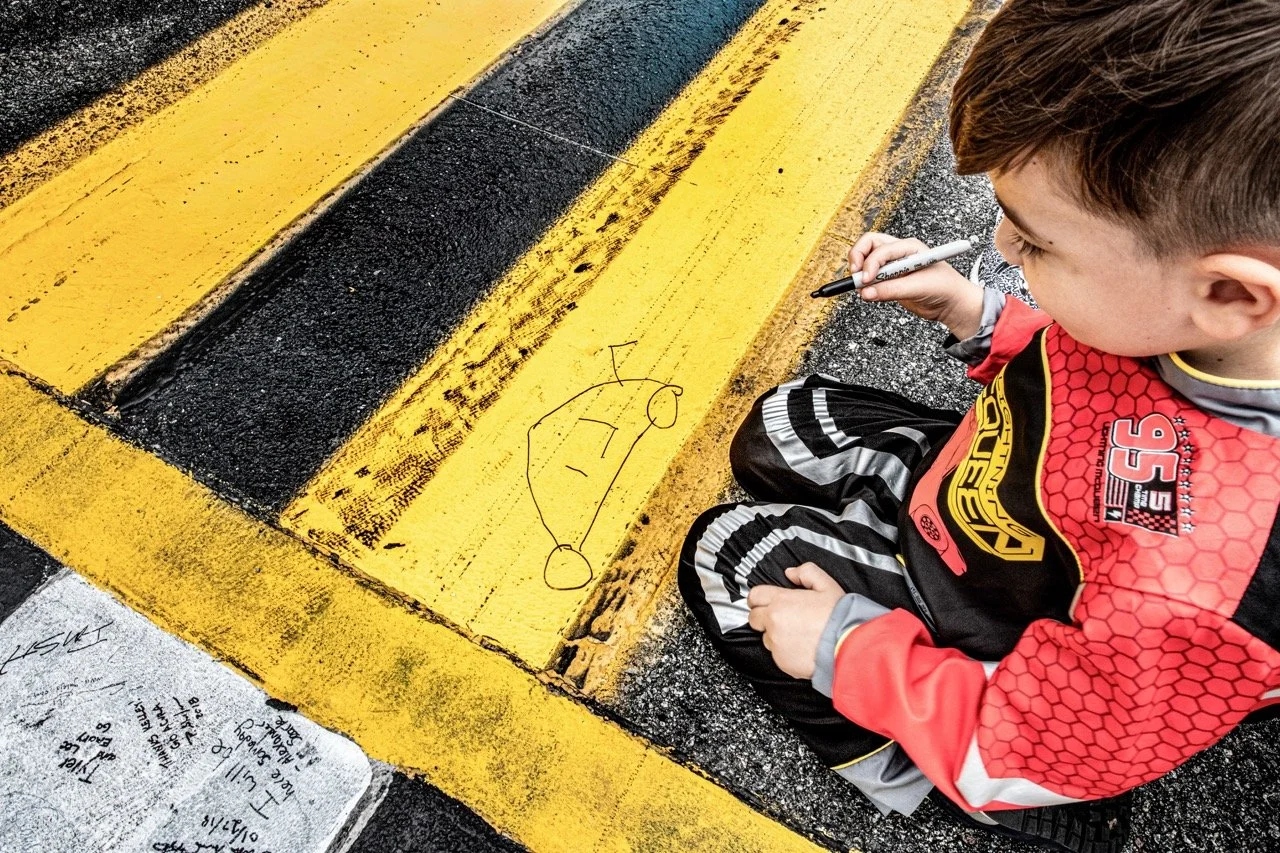
“Dream of a Child.” Photo by D. Paul Graham. Among the echoes of racing legends, a young boy draws a future only he can see. Daytona International Speedway circa 2018
As I approached my 64th year on this spinning madhouse with excellent sun rises and sunsets, I found myself reflecting more than usual. Perhaps wisdom is finally arriving, although with six decades of tuition at the University of Life, I should have earned a doctorate by now. It is clear to me that I may never graduate and I’m good with that.
Sixty-four years have delivered successes, spectacular failures and mistakes, extraordinary memories, and enough hindsight to appreciate the value of foresight. Lately, though, I've been thinking less about the years behind me and more about what I may have left behind.
Which brings me to the photograph. I took this image of the young boy sitting on the start-finish line at Daytona International Speedway. Perhaps he's imagining winning the Rolex 24 or designing the fastest car ever built. No budgets, engineering limitations, or committees explaining why it can't be done.
Just a boy, a blank square on the racetrack, and an imagination without speed limits. The irony is wonderful. He's facing the finish line, yet everything in his world is just beginning.
Somewhere between childhood and our first 401K contribution, many of us have traded imagination for practicality, curiosity for certainty, and occasionally mistaking cynicism for wisdom. We’ve become remarkably good at explaining why things can't be done.
With 64 candles approaching a fire-code violation, I'm convinced growing older and growing up are entirely different propositions. The former is unavoidable. The latter deserves some skepticism.
Perhaps the secret isn't recapturing our youth, but remembering which parts were worth keeping. This morning's M5T explores five child-like qualities we should never outgrow.
1. WONDER. NEVER STOP BEING AMAZED. Children are wonderfully unimpressed by our explanations of the ordinary. A butterfly is a miracle. A cardboard box is a spaceship. A puddle is an invitation to jump and splash. Asking why five, or more likely, fifty consecutive times is apparently a perfectly reasonable interrogation technique.
We as adults, meanwhile, have developed the unfortunate habit of taking extraordinary things for granted. We can watch a sunrise, communicate instantly across continents, or witness a rocket returning from space and barely look up from our phones. Familiarity, it seems, is wonder's greatest enemy.
The world hasn't become less remarkable. I think it’s that we've become less attentive. Stay curious. Ask questions. Look closer. The world is still filled with astonishing things, even if we've convinced ourselves that we've seen them all.
2. POSSIBILITY. DRAW BEFORE YOU MEASURE. Ask a child what they want to become, and you'll hear astronaut, race car driver, veterinarian, president, or perhaps all four before lunch. Ask an adult about a new idea, and you'll likely receive a detailed explanation of why it won't work, complete with supporting spreadsheets.
Children begin with “what if?” Adults begin with “yes, but.” Somewhere between those two comments, an extraordinary number of dreams quietly disappear.
Experience teaches us that not every ambition is achievable and not every idea deserves investment. But imagination should be given the freedom to explore before practicality is invited to chair the meeting.
After all, nearly everything we now consider ordinary began as someone's unreasonable idea. Give your dreams a little room before introducing them to reality. The first draft of possibility rarely needs a financial feasibility study.
3. RESILIENCE. FALL DOWN, GET UP, REPEAT. We’ve all watched a child learning to walk. They fall. They get up. They fall again. They occasionally collide with furniture, reconsider their strategy, and then proceed with remarkable determination. At no point do they announce that walking simply isn't their core competency.
Adults, on the other hand, can turn a single disappointment into an elaborate argument for never trying again. We become increasingly concerned about failure, embarrassment, and what other people might think. We protect our reputations so carefully that sometimes we stop taking the very risks that might make life interesting.
Children understand something that adults have complicated. Falling is part of learning, not proof that learning should stop. Failure is an event, not an identity. Dust yourself off, adjust your approach, and keep moving. The furniture may still win occasionally.
4. JOY. CELEBRATE THE SMALL VICTORIES. Children possess an extraordinary ability to find happiness in things that cost absolutely nothing. A dog wagging its tail. An ice cream cone. Running through a sprinkler. Finding a particularly impressive stick.
Adults tend to require more elaborate arrangements. We postpone happiness until the next promotion, the next purchase, the next vacation, or the moment when everything finally falls into place. Which, inconveniently, seems to be scheduled for some-time after never.
Children don't wait for perfect circumstances to enjoy an imperfect day. They celebrate what is directly in front of them. That’s why their laughter is so wonderfully contagious. It's spontaneous, unfiltered, and completely unconcerned with whether the moment is sufficiently important to justify a gut-wrenching laugh.
Stop treating joy as the reward for completing everything else. Celebrate the ordinary. Sometimes the smallest moments become the largest memories.
5. AUTHENTICITY. BE WHO YOU WERE BEFORE THE WORLD DECIDED. Children arrive in this world blissfully unaware of personal branding, social expectations, professional positioning, or the exhausting business of impressing strangers. They laugh loudly, ask uncomfortable questions, make honest observations, wear mismatched socks, dance when music plays, and will tell you precisely what they think of your weight, your haircut, or that strange curly thing under your nose. They are, for better or worse, entirely themselves.
Then the world begins offering suggestions. Be more serious. Be more successful. Be more like everyone else. Don't look foolish. Don't say that. Don't try that. What will people think? Eventually, we become so skilled at presenting the version of ourselves we believe others expect that we risk losing touch with the person underneath. Maturity should refine our character, not erase our individuality. The goal isn't to abandon responsibility or disregard others. It's to preserve the courage to be genuine, enthusiastic, occasionally ridiculous, and unapologetically human.
Growing older should make us wiser, not less ourselves. Keep the parts of your personality that make you unmistakably you. Especially, and most importantly, the parts that occasionally make you laugh at yourself.
So. Back to the boy at Daytona. He doesn't know whether he'll ever race there, design a championship-winning machine, or pursue anything involving automobiles. At that moment, none of that matters. He's simply dreaming without asking permission.
Perhaps that's what being child-like is really about. Not refusing to grow older, but refusing to surrender the wonder, imagination, resilience, joy, and authenticity that made growing up such an extraordinary adventure.
I've come to appreciate that life isn't measured solely by the laps completed, but by the enthusiasm we bring to the ones still ahead. We can't return to childhood, nor should we surrender the wisdom that comes with age. But we can reclaim a little of that fearless imagination. We can still start with blank sheets of paper and a box of 64 Crayola crayons. The greatest tragedy isn't that we grow older. It's that somewhere along the way, we put down our crayons.
Here's to a week of crayons in hand, mischief in our hearts, and absolutely no intention of acting our age.
© D. Paul Graham / imageGRAHAM, llc All rights Reserved.
Paul continues to color outside the lines, mostly because he never agreed to the lines.
Subscribe to “Monday 5 Things” by clicking here: www.Monday5Things.com
Do you know someone who could use a better Monday? Send this their way. You’ll be doing public service.
You can reach Paul by email at dpg@imagegraham.com
“Monday 5 Things” ™ and M5T ™ are trademarks of D. Paul Graham
“Monday 5 Things” is published by imageGRAHAM, llc