“Monday 5 Things” ….. Lyrics that Linger …..
26.08.31 by D. Paul Graham
Because some songs take four minutes to play and over forty years to understand.
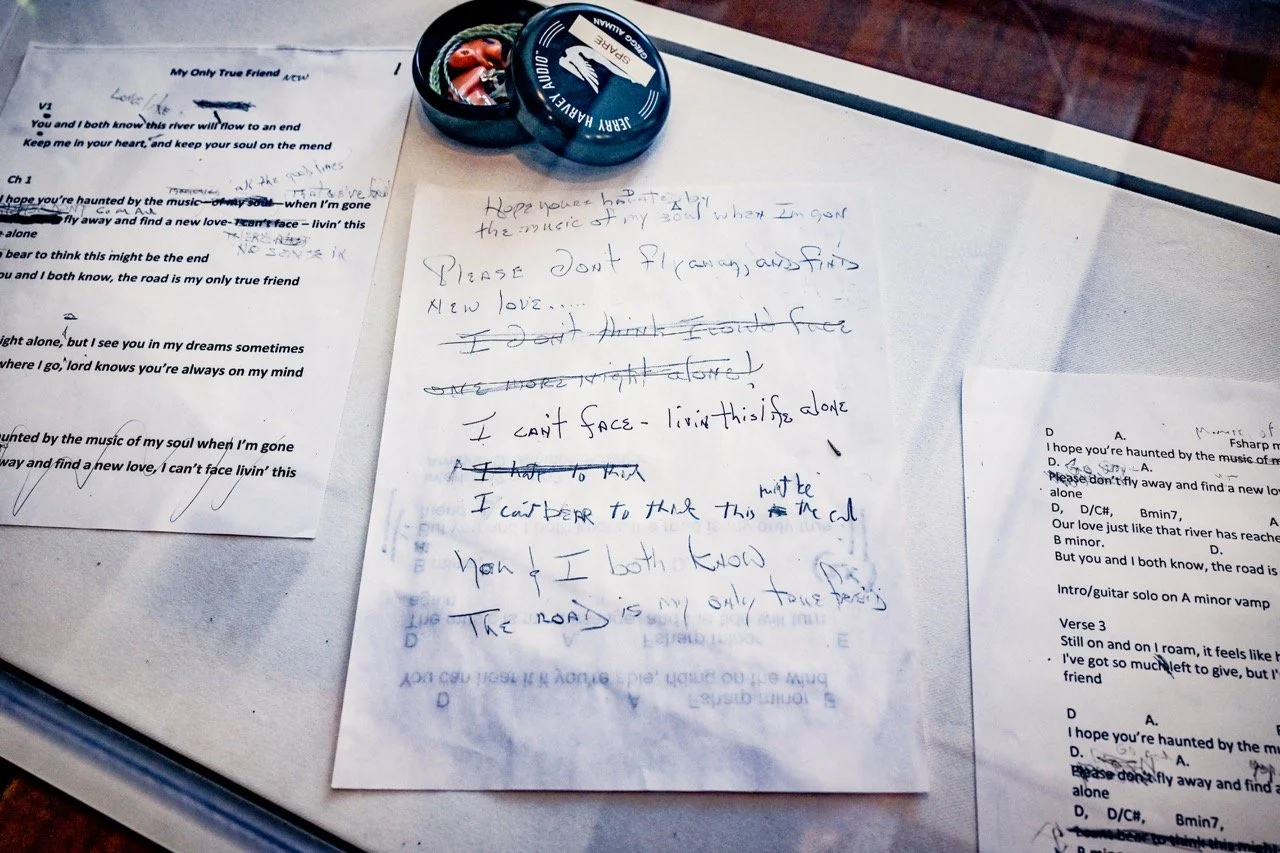
“My Only True Friend” Original lyric sheets by Gregg Allman, cowritten with Scott Sharrad for ‘Southern Blood.’ Allman’s final song and album released posthumously in 2017. A final song. A handwritten artifact. A glimpse into the closing pages of an American music legend. Photo by D. Paul Graham. The Big House, Macon Georgia 2026.
There are songs we hear at one age and then understand at another. At first, they belong to a moment. A crowded room, air drumming during a long drive, a person we once knew, or a version of ourselves we barely recognize now.
We remember the melody because it carries the memory. Sometimes a single line survives everything else. It follows us quietly, gathering meaning as we age with experience and wisdom. That’s the peculiar power of a great song.
A great song lyric doesn’t insist on being understood when we first hear it. It waits for life to provide the translation. Love changes its meaning. So does loss, ambition, regret, and forgiveness. The disappointment of not getting what we were certain we needed. The surprise of discovering that something we barely noticed would matter deeply later.
This morning’s M5T shares five lyrics that, to me, once sounded memorable and eventually became personal.
1. “TURN AROUND AND SAY GOOD MORNING TO THE NIGHT.” Elton John, Mona Lisas and Mad Hatters. This song is Bernie Taupin’s reflections on New York. Not the postcard version. The honest one. The gritty one. The city of beauty and loneliness, possibility and disappointment, dreamers and people who discovered the dream was more complicated than advertised. There is a kind of awakening in the song. You arrive believing one thing. Life shows you another.
Taupin then offers that extraordinary contradiction. “Turn around and say good morning to the night.” Whatever Taupin’s meaning may have been, I’ve always loved that line because it captures something I’ve experienced repeatedly without ever having a particularly good phrase for it. Beginnings and endings rarely announce themselves separately. They overlap.
Some of the biggest changes in my life have arrived that way. Somethings I thought would continue didn’t. A plan I was certain about changed. A friendship shifted. A season ended. A door closed before I was ready to admit I’d been standing in front of it far too long.
At the time, I usually focused on what was disappearing. That seems to be human nature. We notice the loss before we notice the opening it creates. Looking back, I can see that usually something else was often beginning at exactly the same moment. Sometimes quietly. Sometimes inconveniently. Sometimes in a form I would never have chosen for myself.
Life rarely gives us a clean transition with neatly labeled exits and entrances. There is no announcement saying, “This part is over. The next part starts Monday.” It just happens. One chapter begins while you are still trying to understand the last one. That’s what I hear now when Elton sings that line.
Not forced optimism. Not pretending darkness is daylight. Something subtler. The recognition that an ending doesn’t necessarily mean nothing is beginning. Sometimes the dark soul of the night is far too real. Sometimes the only sensible thing to do is turn around, acknowledge where you are, and say good morning to the night.
2. “YEAH, YOU BLEED JUST TO KNOW YOU’RE ALIVE.” Goo Goo Dolls, Iris. Iris is fundamentally a song about wanting to be known. Really known. Not admired from a distance. Not known through the polished version we offer the world. Just known.
That’s what makes the song work. There is vulnerability running through it from beginning to end. The willingness to risk pain in exchange for connection. Then comes the line, “Yeah, you bleed just to know you’re alive.”
When I first heard it, I thought it was brilliantly dramatic. The best songs often are. Today it feels considerably less dramatic and significantly more accurate.
Most things worth caring deeply about carry some risk. Love does. Friendship does. Family does. Trying something new does. So does telling someone what you really think, admitting when you were wrong, trusting someone after being disappointed, or putting part of yourself into something without knowing how it will be received.
That’s the uncomfortable bargain. If you care, you become vulnerable. If you love, you become vulnerable. If you hope, you become vulnerable. There’s no way to participate fully in life while remaining completely protected from it.
I spent years thinking strength meant ignoring, avoiding, and refusing to acknowledge bruises and pain. I now realize that strength is being willing to stay vulnerable despite the bruises and pain. I don’t think pain itself proves we are alive. There is already enough suffering in the world without romanticizing it. Perhaps vulnerability is the proof that you care deeply enough to accept that life still has the power to wound you.
I’ve accumulated a few scars over the years. Some earned, some unnecessary, some self-inflicted, and a few scars I probably should have seen coming. In retrospect, I would much rather have the scars than the shelter of a life without risk.
3. “I AM… I SAID.” Neil Diamond, I Am… I Said. Neil Diamond wrote this anthem during a period when he was struggling with success, identity, loneliness, depression, and the feeling of not belonging anywhere. The song isn’t really a declaration of confidence. It’s almost the opposite. It’s Diamond calling out into the world trying to establish that he exists. “I am, I said.”
Then comes the painful part. No one hears. There is something deeply human about that. Most of us spend a good portion of life collecting descriptions of ourselves. What we do. Where we live. What we’ve accomplished. Who we know. What we own. What other people think of us.
All can be useful descriptions. They can also become dangerously convincing. There have been, and continue to be, times in my life when I confused the role with the person. When achievement felt like identity. When being needed felt suspiciously close to being valued. When a full calendar looked like evidence of importance. Age has made me less convinced by all of that.
Roles change. Status changes. People move on. Things that once seemed enormously important eventually become stories you tell over dinner, assuming anyone at the table cares enough to listen.
Underneath all of that is the harder question. Who are you when nobody is asking what you do? I find that question infinitely more interesting now than I once did. There are moments when I feel closest to the answer. A long conversation with someone I care about. Writing something down before I’ve decided whether anyone else should ever read it. Moments when there is nothing to prove. No role to perform. No audience to convince.
Which is why “I Am… I Said” resonates more with me now. It feels stripped down, raw, and full of consequence. Before the résumé. Before accomplishment. Before explanation. I am. I said. Period.
There is freedom in that. There is also a challenge. Eventually each of us must decide what comes after those words when nobody else is writing the description for us.
4. “YOU CAN’T ALWAYS GET WHAT YOU WANT.” The Rolling Stones, You Can’t Always Get What You Want. This may be one of the few philosophical truths that works equally well as a rock classic and parental advice. The song itself is more complicated than the chorus suggests.
It moves through disappointment, desire, compromise, and the uncomfortable realization that wanting something doesn’t entitle us to it. Then comes the qualification everyone remembers. “But if you try sometimes well, you just might find you get what you need.”
I hear that differently now than I did when I was younger. If we’re honest with ourselves, we spend a large part of our life wanting things. Outcomes, opportunities, answers, approval, timing, and certainty. We want people to behave differently, circumstances to cooperate, and occasionally for the universe to respect the schedule that we created. There is nothing inherently wrong with wanting. Ambition can be useful. Desire keeps us motivated. Curiosity makes life interesting.
However, wanting has a way of making its object seem more important than it may ultimately prove to be. There are things I once desperately wanted that barely matter to me now. Opportunities that seemed enormous at the time that later became mere footnotes. Relationships I tried too hard to preserve. Answers I thought I needed immediately. Situations where I was disappointed by the outcome only to discover later that the alternative led somewhere far better.
Hindsight is wonderfully smug. It explains everything after the fact, but in the moment, disappointment still feels like disappointment. When you don’t get the result you expected, nobody immediately hands you a card explaining how this will all make perfect sense seven years from now.
Quite often you just get the answer no. Then you decide what to do with it. I’ve become less offended by no than I once was. Not entirely. I still prefer yes, but experience has taught me that no is not always the same thing as wrong.
The difference between want and need is usually obvious only after the fact. That may be the wisdom buried in the song. We know what we want because desire is immediate. Understanding what we need make take years.
5. “IT IS WELL WITH MY SOUL.” Horatio Spafford, It Is Well with My Soul. This line is intensely different from the other four. It isn’t simply poetic. It carries the weight of circumstances of personal loss behind it. Spafford wrote the hymn in 1873 after the unimaginable deaths of his four daughters in a shipwreck. Knowing the circumstances of what he wrote transforms the line from reassurance into something far more profound. Faith in the face of devastation. “It is well with my soul” was not written from a place of peace, but from the depths of unthinkable loss and sorrow. Which is precisely what makes the line so powerful.
I have always been struck by the distinction. Spafford didn’t say everything is well. He said something deep inside him, his very soul, was. That is a much more arduous and profound declaration. For years, I treated peace like the incentive for getting life under control, which, as it turns out, is an unreliable system. Life keeps generating additional material. One problem gets solved and another quietly joins the queue. There’s always another decision, another uncertainty, another person you care about, or another situation beyond your control.
That’s precisely what makes this lyric increasingly meaningful to me. Peace can’t depend entirely upon conditions being peaceful. I’ve had times when, to others, my life looked beautiful on the outside, while inside, I felt painfully empty and dead. I’ve had other moments when almost nothing felt certain, yet beneath the uncertainty was a profound calm that could only come from my faith.
I don’t pretend to have mastered that. Far from it. But I recognize it when it appears. It can come from unexpected revelations during prayer before the day begins making its demands, early morning coffee with LA in our tree house, spirited drives on backroads with the whine of high rpms behind me, sitting and thinking without any immediate demand on my attention, or those moments when nothing has necessarily been solved, yet nothing needs to be solved for that moment either. Then there are those moments when calm runs deeper than circumstance. In the most turbulent storms of life, faith creates a stillness that makes no logical sense, a profound assurance that, even when the outcome is uncertain and the path ahead is obscured, I am not facing it alone. The storm may still rage, but somewhere beneath it remains an unshaken peace.
Mick tells us we can’t always get what we want, but what really happens when we don’t? Can we still be okay? Spafford raises existential questions that are much, much deeper than that. Can our circumstances remain chaotic and painful while our soul remains at peace? Can our faith remain intact even when shaken to the very core of our beliefs and understanding?
A truthful answer to those questions may be some of the harder things we spend a lifetime figuring out. I certainly haven’t perfected it, but I understand the line more now than I once did. I think perhaps that’s enough, for today.
Here’s to a week of the lyrics that linger in your life.
© 2026 D. Paul Graham, All Rights Reserved.
Paul continues to sing “I Am… I Said” in his car at the top of his lungs with tears on his cheeks, while drivers at stoplights regret making eye contact.
Subscribe to “Monday 5 Things” by clicking here: www.Monday5Things.com
Know someone who could use a better Monday? Send this their way. You’ll be doing public service.
You can reach Paul by email at dpg@imagegraham.com
“Monday 5 Things” ™ and M5T ™ are trademarks of D. Paul Graham
“Monday 5 Things” is published by imageGRAHAM, llc