“Monday 5 Things”….. A Republic, If You Can Keep It …..
260706 By D. Paul Graham
Because every ordinary Monday is another chance to strengthen an extraordinary Republic.
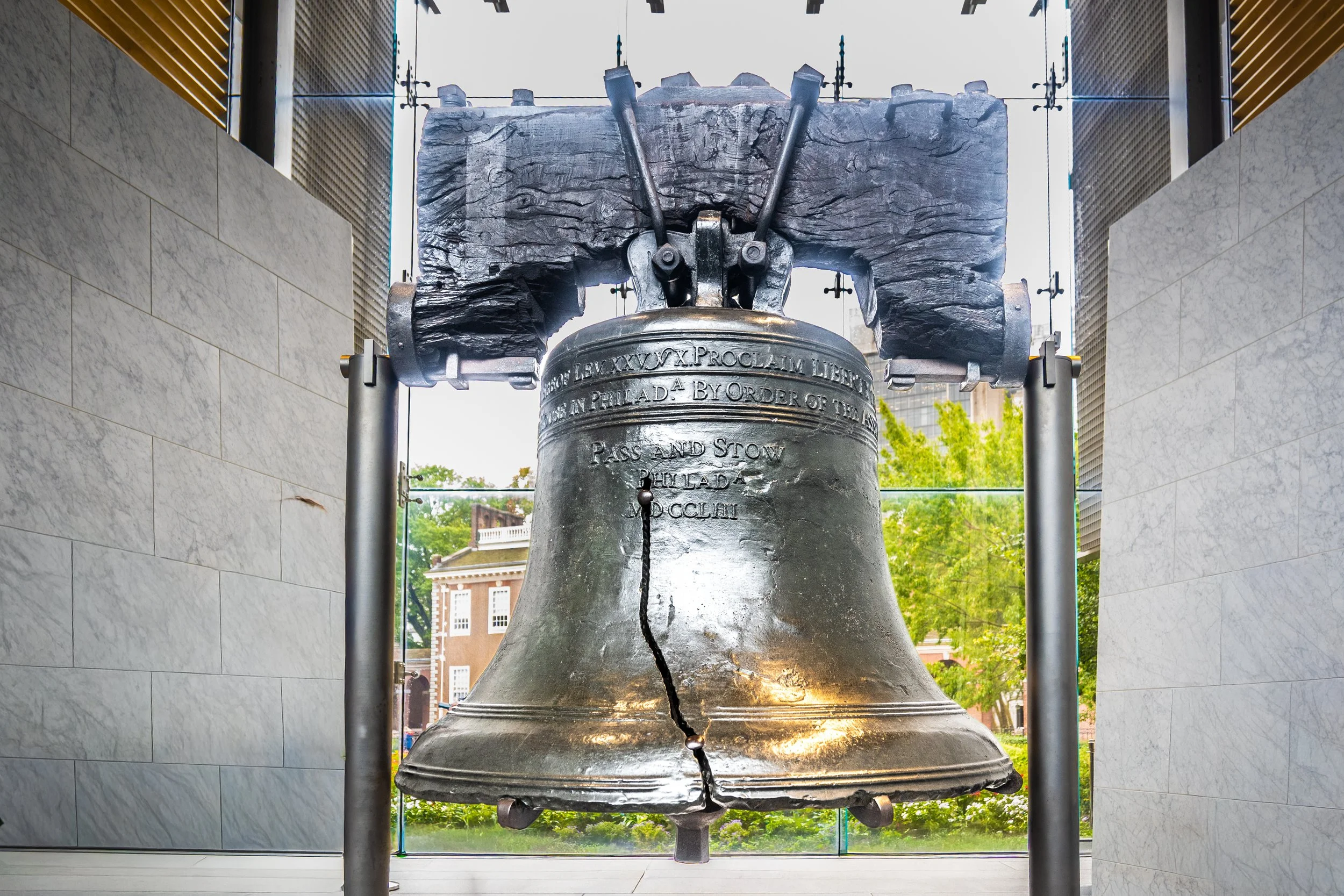
“Cracked but not Broken” The Liberty Bell no longer rings, yet its message echoes louder than ever. Liberty is not inherited by accident. Every generation must choose to preserve it. Photo by D. Paul Graham, Philadelphia 2023
Imagine someone handed you something priceless. Not something you bought. Not something you earned. Something entrusted to your care. It had already survived wars and recessions, triumphs and scandals, family farms and moon landings, civil rights marches and corner diners, baseball games and Sunday sermons, small businesses, and millions of wonderfully ordinary Tuesdays. Generation after generation carried it for a while. Some protected it. Some neglected it. Others quietly repaired the damage left behind.
Then, without ceremony, they placed it into your hands. That's America.
Yesterday, the United States celebrated its 250th birthday. Two hundred and fifty years. For a person, it's unimaginable. For an idea, it's extraordinary. History is filled with empires that rose through conquest only to collapse under the weight of their own arrogance.
America was never intended to be an empire. It was something far more fragile and far more demanding. It was an experiment. Could ordinary people govern themselves? Could liberty survive disagreement? Could freedom outlast fear? Could citizens be trusted with responsibilities once reserved for kings? No one knew.
Not even the fifty-six men who signed the Declaration of Independence. They weren't trying to make history. They were risking everything on the possibility that free people could build something the world had rarely seen. Their signatures were more than ink. They were acts of treason against the most powerful empire on earth.
It's easy to admire that courage from a distance. It's harder to imagine the silence that must have settled over the room after the final signature dried. They knew what might come next. So did their families. Still, they signed, not because success was guaranteed, but because some causes are worth risking failure for.
A decade later, as Benjamin Franklin left the Constitutional Convention, a woman reportedly asked, "Well, Doctor, what have we got, a republic or a monarchy?" Franklin's reply has echoed for nearly two and a half centuries. "A republic, if you can keep it." Perhaps no sentence captures the American experiment more honestly. It offers no guarantee of success. It simply places the responsibility where it has always belonged. With the ordinary citizens of the greatest country in the world.
Two hundred and fifty years later, Franklin's challenge remains unchanged. Can we keep it? This morning's Monday 5 Things reflects on five enduring truths about this extraordinary Republic called the United States of America.
1. NOTHING THIS VALUABLE MAINTAINS ITSELF. Anyone who has ever owned an old house knows the routine. The moment you finish repairing one thing, something else starts making a strange noise. Paint peels. Roofs leak. Wood warps. The air conditioner inevitably chooses the hottest day of the year to announce its retirement.
Nothing valuable stays healthy by accident. Not marriages, not businesses, not friendships, not communities, and certainly not a Republic. Freedom is often described as a gift. It is. But even gifts require stewardship. Our grandparents understood that instinctively. They repaired instead of replaced. They mended fences, sharpened tools, polished shoes, balanced checkbooks, rotated tires, and somehow coaxed another decade out of a refrigerator that had no business still running.
Our generation has grown accustomed to replacing things. History reminds us that Republics don't come with that option. Every generation inherits institutions it didn't build. Courts, schools, churches, libraries, neighborhood charities, volunteer fire departments, and Little League fields. None of them sustain themselves. They endure because ordinary people quietly decide they're worth preserving.
That's the part history books rarely celebrate. America has never depended solely on presidents or generals. It has depended on parents reading bedtime stories, teachers staying after the bell, business owners giving someone their first job, neighbors checking on the elderly after a storm, and citizens showing up for jury duty when it would have been easier not to.
The Republic has always been repaired from the ground up. Just like an old house. The question isn't whether America needs work. Every generation has answered that with an obvious yes.
The question is whether we'll be the generation that picks up the hammer.
2. THE FOUNDERS WERE REMARKABLY ORDINARY. One of history's greatest mistakes is turning remarkable people into marble statues. The moment we imagine the Founders as flawless heroes, we stop learning from them. They weren't flawless. They argued constantly. They disagreed about almost everything. They frustrated one another. Benjamin Franklin possessed a legendary sense of humor. John Adams could fill an afternoon with strong opinions. Thomas Jefferson rewrote sentences obsessively, proving that even in 1776 good writing required editing. Alexander Hamilton rarely met an argument he wasn't willing to continue. George Washington worried more than portraits suggest.
They were ambitious, brilliant, and imperfect. They were entirely human, which is precisely why their accomplishment matters. They didn't wait until everyone agreed. They didn't postpone action until every problem had been solved. They understood that progress is almost always built by imperfect people willing to work together despite imperfect circumstances.
That lesson reaches far beyond Philadelphia. The Founders remind us that history belongs less often to those who waited than to those who began. Not recklessly. Not carelessly. But courageously.
America itself began as an unfinished first draft. Perhaps our lives do too.
3. AMERICA'S GREATEST EXPORT ISN'T TECHNOLOGY. IT'S HOPE. Ask someone halfway around the world what America exports and you'll probably hear a familiar list of airplanes, movies, blue jeans, jazz, smartphones, software, fast food, pickup trucks, and the occasional superhero wearing a cape.
All true. But America's greatest export has never fit inside a shipping container. It's hope.
For 250 years, people have crossed oceans, deserts, mountains, and borders because they believed life could be better here. That belief has built more futures than any government program ever could. Hope persuaded families to leave everything familiar behind. It inspired entrepreneurs to mortgage their homes for businesses that existed only in notebooks, inventors to chase ideas everyone else dismissed, and students to become the first in their families to earn a college degree. It whispered to exhausted parents working two jobs, "Keep going." It convinced immigrants that unfamiliar language, customs, and uncertainty were prices worth paying for opportunities their children had yet to imagine.
Hope doesn't appear in economic reports. Wall Street doesn't trade it. Politicians rarely campaign on it. Yet it remains one of America's greatest competitive advantages. The freedom to begin again. That simple yet profound idea has shaped this nation from the beginning. America has always been a place of second chances. Sometimes third. Occasionally fourth. Some of us have built entire careers on fifth chances.
One of my favorite questions to ask is, “Who are you becoming?” Not who were you. Not who does everyone think you are. Who are you becoming? Perhaps that should be America's question as well.
This country has never been defined solely by where it started. It has been defined by where it keeps choosing to go. That's why millions still dream of coming here. Not because America promises an easy life, but because it offers the freedom to pursue a meaningful one.
There's a profound difference. Comfort builds contentment. Hope builds civilizations.
4. THE QUIET ARCHITECTURE OF THE REPUBLIC. Hollywood has convinced us that heroes arrive with dramatic music. Real life is quieter. Most heroes show up carrying a lunchbox, a backpack, a tool belt, a stethoscope, or a diaper bag.
Every Independence Day we celebrate extraordinary moments. The signing of the Declaration, the flag at Iwo Jima, the moon landing. Those moments deserve celebrating. But nations aren't sustained by extraordinary moments.
They're sustained by ordinary mornings. By teachers unlocking classrooms before sunrise. Nurses beginning twelve-hour shifts while the rest of us are still reaching for the snooze button. Military families celebrating birthdays over video calls from halfway around the world. Police officers, firefighters, and paramedics running toward danger while others run away. By truck drivers who keep grocery shelves stocked. Farmers planting seeds they cannot yet see. Small business owners unlocking the front door with no guarantee that customers will walk through it. Volunteers coaching Little League because every child deserves someone cheering from the dugout. Grandparents teaching grandchildren how to fish, how to pray, and how to shake hands.
Those moments rarely trend online but they shape civilizations. America has endured for 250 years because millions of ordinary people chose responsibility over recognition. No television cameras. No applause. No statues. Just quiet faithfulness.
History remembers George Washington's crossing of the Delaware River. It rarely remembers the blacksmith repairing wagon wheels in the middle of winter, the woman keeping the family farm alive while her husband served overseas, the immigrant opening the neighborhood grocery store, or the school custodian who learned every student's name because he believed everyone deserved to be seen.
Their names will likely never appear in history books, but they are written into the story of America. Perhaps patriotism isn't measured by how loudly we sing "The Star-Spangled Banner." Perhaps it's measured by how faithfully we care for one another after the music ends. The most patriotic thing you do this week may not involve a flag at all. It may be encouraging a coworker, mentoring a young employee, checking in on an elderly neighbor, supporting a local business, or teaching your children that character matters more than convenience.
The Republic has never rested solely on famous names. It has always rested on faithful ones and that's good news.
Because every one of us can become one.
5. WE DON'T OWN AMERICA. WE STEWARD IT. The Greek statesman and general, Pericles has been quoted, "What you leave behind is not what is engraved in stone monuments, but what is woven into the lives of others." It’s an important principle.
The same is true of America. We often say, "This is our country." In one sense, that's true. But in a far more important sense, it isn't. We're simply its current stewards. None of us wrote the Declaration of Independence. We didn't draft the Constitution, preserve the Union, storm the beaches of Normandy, march across the Edmund Pettus Bridge, or leave footprints on the moon. Others carried those batons.
Now it's in our hands. That changes the question of, "What does America owe me?" to "What kind of America will I leave behind?" Such a far better question.
The older I get, the more I realize that legacy has very little to do with accolades and monuments. Legacy is what continues because you lived and what you chose to be woven into the lives of others. Nations are built the same way. One generation plants trees. The next enjoys the shade. Then it's their turn to plant.
We've grown accustomed to thinking in election cycles. History thinks in centuries. The men who signed the Declaration weren't trying to solve the problems of July 1776. They were trying to build something that would outlive them.
Would they believe, 250 years later, that people would still celebrate what they began. Perhaps. Would they have imagined interstate highways, jet aircraft, artificial intelligence, or instant communication across continents? Probably not.
I choose to believe that they hoped for something even greater. They wanted to create a nation where free people would remain free, that self-government would endure, and that ordinary citizens would continue doing the extraordinary work required to preserve both.
That responsibility now belongs to us, our generation. Not politicians. Not talking-head commentators. Not the next generation. Us. Every generation is given exactly one chapter in the American story.
The only question is whether ours will be remembered for faithfully passing the Republic to those who follow, or quietly assuming someone else would.
The fireworks are over. The work continues. Here's to waking up on July 5th ready to carry the baton faithfully and purposefully before passing it to the next generation.
© 2026 D. Paul Graham, All Rights Reserved
Paul continues to suspect Benjamin Franklin would have had strong opinions about social media.
Know someone who still believes America is worth keeping? Please forward this to them.
Subscribe to “Monday 5 Things” by clicking here: www.Monday5Things.com
You can reach Paul by email at dpg@imagegraham.com
“Monday 5 Things” ™ and M5T ™ are trademarks of D. Paul Graham
“Monday 5 Things” is published by imageGRAHAM, llc