“Monday 5 Things” ….. Clarity, Currently Buffering …..
May 04, 2026 by D. Paul Graham
Because Mondays are not asking us to understand the entire future. They are simply asking us to overhear enough of the present to laugh our way through it.
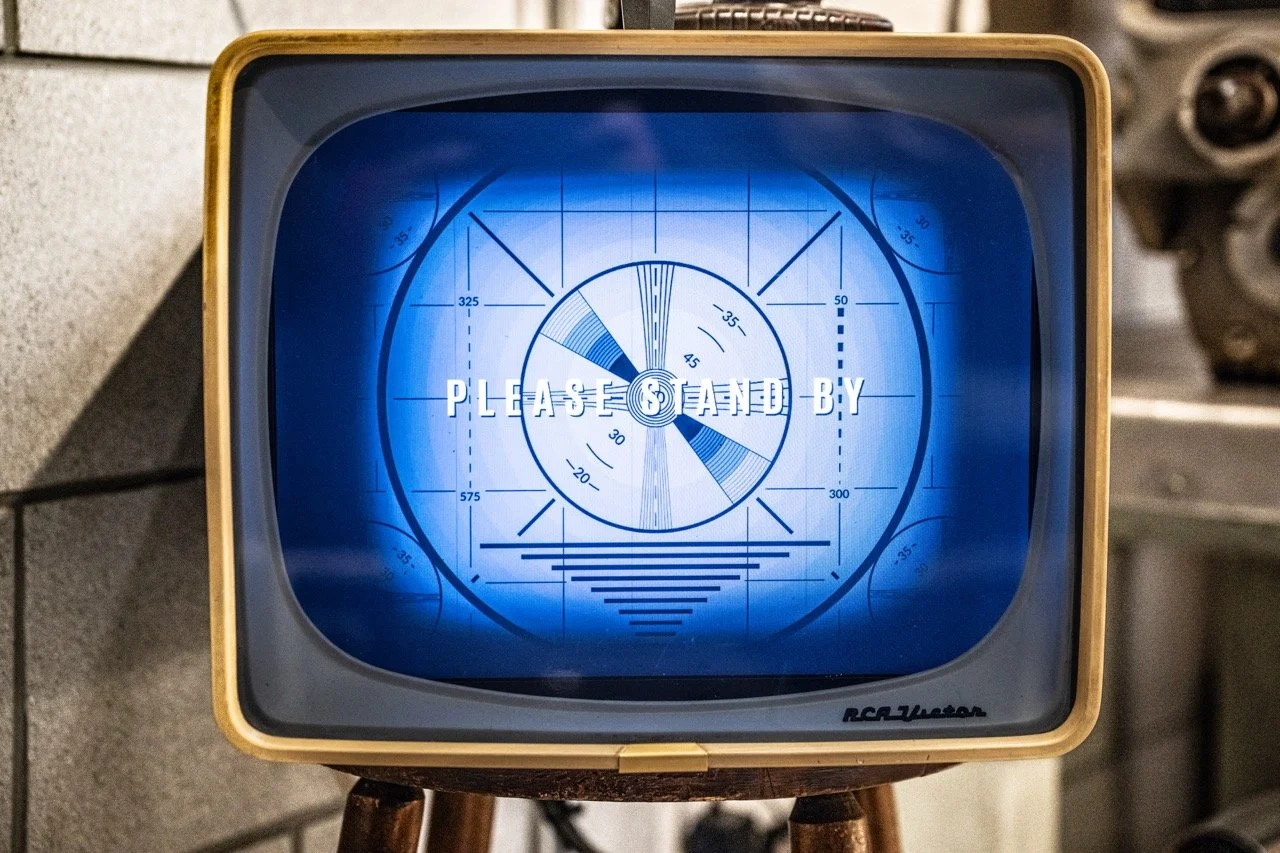
“Please Stand By” Photo by D. Paul Graham, Indianapolis IN 2025
There is wisdom in literature. There is wisdom in silence. There is wisdom in reflection, solitude, long walks, and well-made coffee. But there is also wisdom overheard while standing behind someone at a coffee shop while they say, with full confidence, “I don’t worry about AI taking my job. I’m afraid it will make my presence optional.” And that, my fellow M5Ters, is 2026.
2026 is the year in which everyone is talking about artificial intelligence, authenticity, attention spans, hybrid work, the economy, social media, politics, climate, electric cars, subscription fatigue, and why, somewhere along the way, lunch stopped being a meal and quietly became a financial decision.
Everywhere you go, people are offering commentary. Not always intentionally. Not always accurately. But often brilliantly. The best observations are leaking out of conversations in restaurants, parking lots, airports, waiting rooms, elevators, and group emails and texts where someone still does not understand the difference between “reply” and “reply all.”
So, this morning’s M5T offers up five personal observations from the grand public theater of being alive at this point in history.
1. EVERYONE IS USING AI. Though no one quite trusts it. AI has become the coworker everyone relies on, no one fully understands, and everyone quietly blames when the tone feels off. Comments like “I had AI write it, then I dialed down the executive enthusiasm,” are becoming more common.
AI now writes emails, summarizes meetings, suggests captions, helps with homework, builds decks, edits photos, analyzes spreadsheets, invents brand voices, and occasionally produces sentences that read like a thesaurus got promoted too quickly.
Those who’ve leaned in are already moving past tools. They are using AI as continuity. Systems that don’t just respond but persist. AI remembers how you think, write, and decide. It anticipates what’s next, prepares drafts before you ask, surfaces that nugget of truth and insight buried in hundreds of documents, and connects decisions across days, not just tasks in isolation. AI used in this way doesn’t just summarize the meeting but updates your priorities, your calendar, and next steps across your team. Less assistant, with more extension. Less software, with more you, just faster, quieter, and always one step ahead.
The most common phrase in corporate communication is no longer “circle back.” It’s now: “Make this sound more human.” Asked, of course, to a machine. There’s something rather absurd about outsourcing thought. I keep waiting for HAL 9000 to say, “I’m sorry Dave. I’m afraid I can’t do that. This mission is too important for me to allow you to jeopardize it.”
Stated by a colleague, who shall remain anonymous here, “I don’t want AI to take my job. I want it to attend my 3:30 meeting.” Which may be the real breakthrough. Not artificial general intelligence. Artificial meeting attendance. If AI can nod, say “great point,” and promise to follow up without doing anything, AI may already be middle management material.
2. EVERYONE WANTS AUTHENTICITY. Authenticity has become one of the great performance arts of our time. People want to be real. Brands want to be human. Humans want to be brands. Brands want to have feelings. People want analytics on their feelings.
No one simply posts anymore. They “share a moment.” They “invite the community into a story.” They “lean into vulnerability.” Which used to be called having a bad Tuesday. Somewhere along the way, being authentic started requiring a ring light, a caption strategy, and a clean background that implies you own fewer cords than you actually do.
While I waited for my lunch order recently, I overheard, “I want it to feel effortless, but in a very intentional way.” Of course, that seemingly makes sense in our world today. Effortless intention is the official emotional posture of 2026.
Which may be the reason that we have become a species in crisis. We crave truth but prefer it in portrait mode to post on Instagram. We want raw honesty, but not if there is clutter in the background. We want transparency, but only after smoothing the skin tone and removing the trash can from the corner of the frame.
Don’t get me wrong here. As a photographer, I see nothing wrong with wanting to look your best. But it is worth remembering that the most interesting people in history probably had bad angles, poor lighting, and no idea what their “personal brand” was doing that quarter.
3. THE WORKPLACE HAS BECOME A THEATER PRODUCTION. Performed on multiple desktop screens, this production is called “Can Everyone See My Screen?”
The modern workplace has evolved into a highly sophisticated system for creating, forwarding, discussing, revising, tracking, and rediscovering information that up until recently was obvious. Every company now runs on two things; calendar invites, and shared documents.
No one goes to work anymore. They enter ecosystems. They join calls. They jump into threads. They align cross-functionally. They create visibility. They push things to next week with the grace of a French waiter refusing to notice you.
The workplace vocabulary of 2026 deserves its own thesaurus. “Let’s unpack that.” “Let’s pressure test it.” “Let’s socialize it internally.” “Let’s take this offline.” “Let’s put a pin in it.” Personally, I’m not sure if anything good has ever happened to a pinned thing.
The phrase “take this offline” is especially mysterious, since it usually means moving the conversation from one screen to another screen, where it will continue to not be resolved.
I heard this on a video call, of which the company and executive shall also remain anonymous: “I think we need a Zoom meeting to decide who needs to be in the meeting.” There it is. The snake eating its own calendar invite.
Yet, despite all of this, work gets done. Somehow. Someone sends the invoice. Someone fixes the deck. Someone changes the font. Someone explains EBITDA for the fourth time. Someone says, “quick question” and destroys an afternoon.
Civilization continues. Barely. But with recurring reminders every 15 minutes.
4. THE ALGORITHM IS QUIETLY RUNNING THE ROOM. It doesn’t announce itself. It doesn’t need to. It sits behind every scroll, every Google search, every suggestion, every “you might also like”, subtly arranging what you see, what you miss, and what you begin to believe is normal.
We used to choose what we consumed. Now what we consume is gently chosen for us. I’d like to think not maliciously, not dramatically, but just efficiently. But I’m too much of a cynical realist to believe that.
Pause on a video for three seconds and it learns. Click once and it adjusts. Linger twice and it decides who you are. Offer up more personal information, and over time, it builds a version of you, feeding it back to you as reality. At some point you begin to wonder if you’re discovering things or being assigned them.
That has become the radical societal shift. The algorithm doesn’t just show you content. It shapes your sense of proportion. What matters. What’s urgent. What’s everywhere, even if it isn’t. What’s everyone doing, even if they aren’t. Outrage feels constant. Trends feel universal. Ideas feel obvious because you’ve seen them twelve times before finishing your morning coffee.
Yet, there’s brilliance in the algorithm. It can surface extraordinary work from unknown creators. It can connect people across continents over the most specific, unlikely things. It can put your work, your photos, your words, and your ideas directly in front of the exact audience who will understand and appreciate it.
But it comes with a quiet trade. You gain precision, but you lose randomness. You gain relevance, but you lose surprise. You gain a world that feels tailored, but you lose the one you might have stumbled into.
The algorithm doesn’t control your life. Yet. It just gently suggests what it should look like.
5. WE’RE ALL EXHAUSTED, OVERSTIMULATED, SUSPICIOUS, & SOMEHOW STILL HOPEFUL. The strange thing about 2026 isn’t how much has changed. It’s how much hasn’t changed.
Human nature still responds in the same ways. People are still people. They still make plans they will overcomplicate. They still buy notebooks to become different people. They still say “this year I’m simplifying” while adding three new apps. They still believe the next system will finally fix the old behavior.
Overheard in Staples: “I’m trying to reduce clutter, so I bought a label maker.” This is not decluttering. This is giving your chaos a name badge. Another overheard gem: “I’m not overwhelmed. I’m just aggressively under-prioritized.”
That sentence should be embroidered on every laptop bag in America. We are tired, yes. But we are not done. We still cheer at finish lines. We still watch old movies. We still love cars that make no financial sense. We still stand in museums and stare at beautiful art. We still send texts that say, “Have I mentioned that I love you yet today?” We still laugh in restaurants loud enough to make other tables listen.
Perhaps the best personal observation is that no matter how modern the world gets, humanity keeps sneaking through the cracks. In the overheard joke. In the awkward pause. In the unnecessary purchase. In the friend who calls at exactly the right time. In the stranger who says something absurdly perfect while you wait for your latte.
The future may be automated, optimized, monetized, and algorithmically recommended. But life is still mostly lived by people trying to find their keys, keep their promises, be a good partner, answer their emails, and remember why they walked into the kitchen.
So, this week, pay attention. Not just to the headlines, the notifications, and to the things clamoring and demanding that you give it your attention. Pay attention to the small theater around you. The guy at the airport explaining crypto to someone who clearly just wants a pretzel. The partner at brunch saying you have their full attention, while glancing at the phone screen every 15 seconds. The executive in the elevator whispering to a colleague that “the story is compelling, but the reality is still in development.” The parent at Target telling a child that “Mommy isn’t emotionally prepared for the toy aisle.”
That’s the good stuff. That’s where the truth leaks out.
Here’s to a week of being present in a world that rarely, if ever, pauses.
© 2026 D. Paul Graham, All Rights Reserved
Paul continues to experiment with the future, carefully, curiously, and with just enough skepticism to remain human.
Subscribe to “Monday 5 Things” by clicking here: www.Monday5Things.com
Know someone who could use a better Monday? Send this their way. You’ll be doing public service.
You can reach Paul by email at dpg@imagegraham.com
“Monday 5 Things” ™ and M5T ™ are trademarks of D. Paul Graham
“Monday 5 Things” is published by imageGRAHAM, llc